St Patrick's R C Primary School

Learn. Grow. Shine.

Early Reading and Guided Read

In EYFS and Key Stage 1, an understanding of phonics is taught through multisensory, engaging, discrete sessions.  Phonics sessions are well matched to children’s needs and are taught using systematic synthetic phonics based on the progression of sounds outlined in the Red Rose Letters and Sounds scheme.

Our pupils benefit from:

  • A daily phonics session, based on a model of review, introduction of new learning, practice and applying;
  • Focused directed teaching involving oral and written practice of letters and sounds;
  • A variety of teaching methods, including demonstration, modelling, games, singing and other practical activities.
  • Repetition and teaching of ‘tricky’ words.

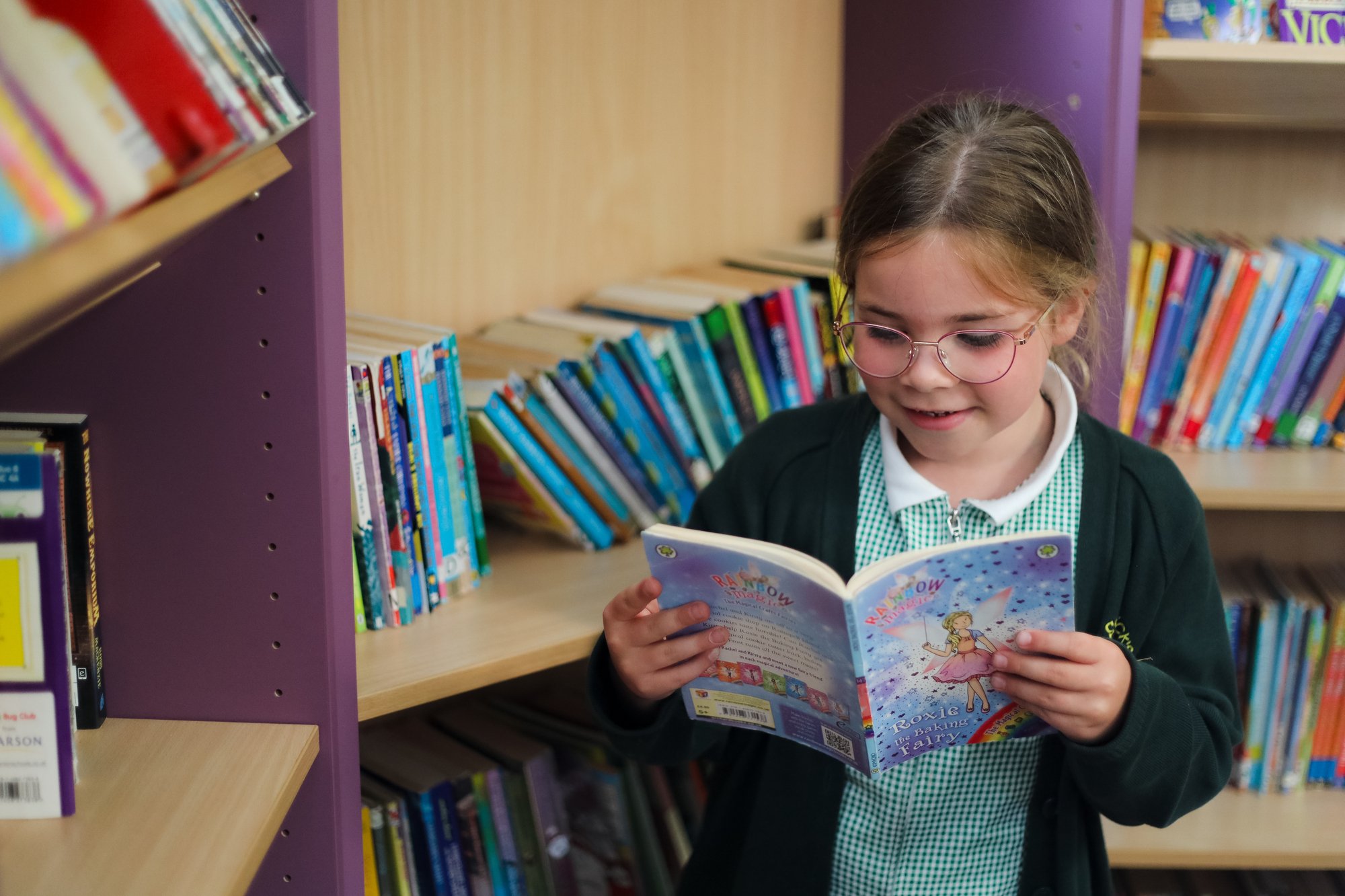
As our children move through the different phonic phases, they will be matched to a phonically decodable book at the appropriate level for the phase they are learning to take home and share with parents.  This will give them further opportunities to practice the skills they are learning in school and reinforce their learning.  Our phonically decodable books come from a wide variety of publishers and each book has been matched to the most appropriate phase.  Children will also access the school library at least once a week, where they will have the opportunity to choose their own books to take home and read for pleasure with their families, helping them to develop a love for reading.

As the children move onto Phase 6 in phonics they broaden their reading with a range of colour banded books. These books have all been assessed by our staff and grouped into appropriate sets that creates a progression from the decodable phonics books right through to free choice reading.  We have designed the system to help pupils develop their skills of blending sounds into words for reading and to help them establish the habit of applying this skill whenever they encounter new words.  The colour banding system supports this practice, providing pupils with reading books that are consistent with their developing phonic knowledge and skill, and their knowledge of common exception words.

Children who find reading more difficult receive additional support targeted to their identified needs.  This may be daily 1:1 reading with an adult, small group phonic interventions or a structured intervention such as fast track phonics.  This may continue into Key Stage 2 where they also have access to a selection of Project X books; these are high interest/lower reading level books. 

Reading for Pleasure                                                                                                  Reading for pleasure is a central part of our culture at St Patrick’s Primary School and we work hard to develop a love of reading amongst our pupils. Children have the opportunity to take part in engaging and enjoyable shared, group and independent reading activities through the daily English lesson and through Guided Reading sessions. During these sessions, which are led by well trained teachers and TAs, our pupils are always encouraged to read for pleasure.

We share a wide variety of diverse novels, picture books and poetry in our classes on a daily basis.  Our pupils have access to a wide range of diverse, exciting, and inspiring texts through our well stocked library and class reading corners.

Our pupils are given the opportunity to develop decoding and literal comprehension skills before working on high order reading skills. During reading lessons, our skilled teachers nurture a love of reading while making rigorous and ongoing assessments of our pupils’ progress. Our staff are skilled at the early identification of at-risk children who struggle to develop early reading skills. At such times, additional support is put in place. 

Parents are asked to read with their children multiple times a week and record their observations and comments in their child’s Reading Diary, provided by the school. This is monitored carefully by class teachers.  Each class has its own system of changing books that will be set out at the beginning of each year.  All our pupils will go home with at least one reading book each week and all children will have access to the school library at least once a week.  This system ensures that our pupils are given regular practice and make rapid progress through the reading stages as well as developing a life-long love for reading.

Once pupils have progressed through the colour book bands they are able to move onto free choice.  Teachers in year groups where this is happening, explicitly teach children how to choose engaging, age appropriate books and then pupils can choose to read books in the classroom, the school or local library, or from home. 

Handwriting                                                                                                          As soon as our children enter Foundation Stage (EYFS) at St Patrick’s, provision is carefully planned to develop and strengthen the fine motor skills needed for writing. Children have regular opportunities to develop their pincer grip, hand strength, coordination and control through activities such as using tweezers, screws and bolts, threading, cutting and sticking, and working with malleable materials such as playdough.

As children develop the necessary strength and control, they are supported to establish an appropriate pencil grip and posture for writing. We encourage children to develop good habits from the outset, which will support their handwriting as they progress through school.

When children begin to form letters in Foundation Stage, they are taught to use the letter formation patters from Red Rose Letters and Sounds. This provides consistency between our phonics and handwriting teaching, helping children to connect the sounds they hear and say with the letters they read and write.

Alongside this, we are introducing the Smooth Start Handwriting model across St Patrick’s. This provides a consistent approach to modelling, practising and applying correct letter and number formation throughout the school.

In Year 1, children continue to develop accurate letter formation, including the use of ascenders and descenders, while developing greater fluency and consistency.

In Year 2, children are introduced to joining letters and begin to develop a fluent joined handwriting style. This is practised and refined throughout Key Stage 2.

In Years 3 and 4, the focus is on developing the legibility, consistency and quality of handwriting across all areas of the curriculum, ensuring that children can maintain their handwriting skills beyond dedicated handwriting lessons.

In Years 5 and 6, the emphasis is on developing stamina, fluency and automaticity, enabling children to maintain clear, legible joined handwriting when writing for longer periods and at greater speed.

Throughout every stage, we want children to develop handwriting that is accurate, fluent, legible, consistent and increasingly automatic, allowing them to concentrate on communicating their ideas rather than the physical process of writing.

Our approach at St Patrick’s is simple: model it, say it, practise it and apply it. This consistency between school, phonics and home will help every child develop a confident and fluent handwriting style.


Writing at St Patrick’s 

At St Patrick’s RC Primary School, Walton-le-Dale, we are proud to use the Lancashire Talk approach to writing from Reception through to Year 6. Developed by Lancashire Professional Development Service (LPDS), the Talk programmes provide a structured approach to developing children’s spoken language, reading and writing through high-quality texts and purposeful writing opportunities. Lancashire describes its English units as supporting schools to develop coherent curriculum pathways, with fiction, non-fiction and poetry units across the primary years.  

Our approach places talk at the heart of writing. Before children are expected to write independently, they are given opportunities to explore ideas, develop vocabulary, discuss language choices and rehearse sentences orally. This helps children to develop the language and confidence they need to become successful writers.

Read → Gather → Write

Across the school, our writing follows a clear and consistent journey:

READ
Children immerse themselves in high-quality texts, exploring characters, vocabulary, language, structure and the features of different genres.

GATHER
Children gather ideas, vocabulary and knowledge that they can draw upon in their own writing. Through discussion, drama, vocabulary work and teacher modelling, children develop the content and language they need.

WRITE
Children then apply what they have learned to produce their own writing for a clear purpose and audience. Teachers explicitly model the writing process before children are given increasing opportunities to write independently.

This approach allows children to see what effective writing looks like, talk about how it works and then apply their learning independently.

A carefully sequenced journey from Reception to Year 6

Our writing curriculum builds progressively throughout the school. In Reception, children develop the foundations for writing through storytelling, oral language, vocabulary development, phonics and early composition. Lancashire's Talk Reception programme similarly places emphasis on language development, storytelling, phonics and early writing, with opportunities to create units of work around quality texts.  

As children progress through Key Stage 1 and Key Stage 2, they encounter an increasingly broad range of fiction, non-fiction and poetry. They develop their vocabulary, sentence construction, grammar, punctuation and composition skills while learning to adapt their writing for different purposes and audiences. Lancashire's Talk programmes extend across Years 1–6, with year-specific programmes designed to support writing outcomes and progression.  

By Year 6, children are expected to draw upon everything they have learned throughout their primary education. They use their reading, vocabulary, grammar and wider knowledge to craft increasingly sophisticated independent writing, while developing the ability to make deliberate choices about purpose, audience, language and structure.

Talk, vocabulary and independence

A key strength of our approach is the relationship between speaking and writing. We want our children to be articulate thinkers who can explain their ideas, listen to others, experiment with language and rehearse their thinking before committing it to paper.

We therefore place a strong emphasis on oracy, vocabulary and sentence development throughout the writing process. Lancashire also highlights spoken language and vocabulary as important foundations for a quality English curriculum.  

As children move through the school, the amount of scaffolding gradually reduces. Our ultimate aim is for every child to become an independent, confident and purposeful writer who can transfer their skills across the curriculum.

Writing for a purpose

We want children to understand that writing is not simply about completing a piece of work. They write to inform, entertain, persuade, explain, describe and communicate their ideas.

Through Lancashire Talk, children experience a range of genres and writing opportunities, including fiction, non-fiction and poetry. The LPDS English units are designed around these different forms and provide opportunities for both modelled and independent writing.  

At St Patrick’s, our aim is for children to leave Year 6 as enthusiastic readers, articulate speakers and confident writers, equipped with the vocabulary, knowledge, grammatical understanding and writing skills they need for the next stage of their education.

Read. Gather. Write. Review. Improve.

Every child. Every voice. Every writer.


Oracy at St Patrick’s

At St Patrick’s RC Primary School, Walton-le-Dale, spoken language is at the heart of our curriculum and underpins the development of confident readers, writers and learners. We recognise that children need opportunities to speak, listen, question, explain and express their ideas in order to develop their understanding and communicate effectively.

Through purposeful discussion, partner and group work, drama, role play, storytelling and whole-class dialogue, children are encouraged to articulate their thoughts, develop their vocabulary and listen respectfully to the ideas of others. Drama provides opportunities for children to step into different roles, explore characters’ thoughts and feelings and develop empathy, imagination and confidence — skills which directly support their reading and writing.

From Reception to Year 6, we deliberately develop children’s oracy, vocabulary and communication skills, helping them to become articulate and confident speakers who can adapt their language for different purposes and audiences. These skills are not only essential for success across the curriculum, but equip our children with the confidence and communication skills they will draw upon throughout their lives.

At St Patrick’s, we believe that every child should have a voice, the confidence to use it and the skills to be heard.

Progression and Key Learning Documents at St Patricks

Name
 Key-Learning-for-EYFS.pdfDownload
 Key-Learning-in-Reading.pdfDownload
 Key-Learning-in-Writing.pdfDownload
 LAPS for Reading in Reception.docx.pdfDownload
 Reading-Learning-and-Progression-Steps-LAPs.pdfDownload
 Writing-Learning-and-Progression-Steps-LAPs.pdfDownload
Showing 1-6 of 6

Early Years Literacy

It is crucial for children to develop a life-long love of reading. Reading consists of two dimensions: language comprehension and word reading.

The videos below explain how we implement three areas of Literacy into our EYFS curriculum at St Patricks.

Reading comprehension

Exploring words

Writing

Early Reading Progression at St Patricks

Speaking and Listening

Author Visits 

Each term we have an author visit to raise the profile of reading, speaking and listening in our school. The children get inspired and love to listen and find out about the authors. It also inspires their writing! We have been lucky to have had visits/zooms with authors such as - eg. Tom Palmer, Keith Harrison, Olaf Falafel, Dan Worsley, Paul Jenkins and Emily Gale.

Recent Reading Roundup Newsletters 

Summer 2 

Summer 1 

Spring 2 

Spring 1 

Autumn 2 

Autumn 1